
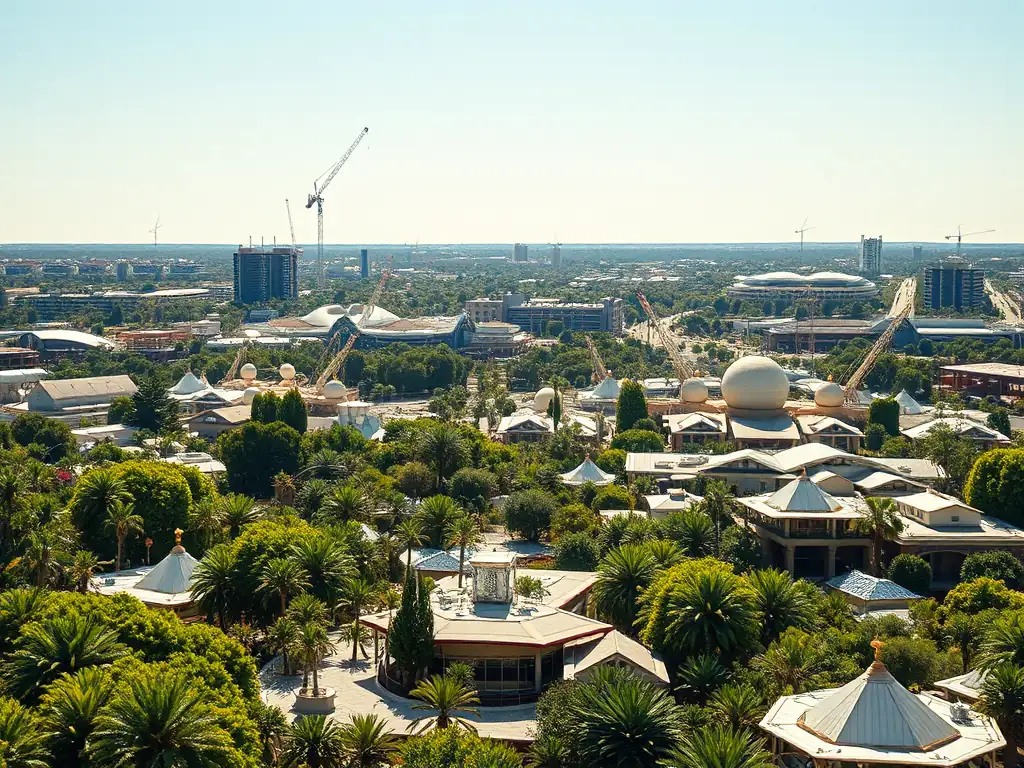
Theme park development and the Gold Coast expansion
Theme park development involves complex large-scale planning to integrate commercial attractions with infrastructure, as demonstrated by the Queensland government’s recent approval of a 30-hectare expansion for Dreamworld. BanksiaPulse reports that this project includes hotels and residential spaces. According to the July 21, 2026, announcement, Dreamworld has pledged $5 million toward road network improvements to manage the increased capacity (Source: Queensland Government). This project balances regional tourism goals against local environmental concerns regarding wildlife corridors.
What is theme park development and how does it differ from regular construction projects?
Theme park development focuses on creating immersive, multi-use environments that combine hospitality, retail, and entertainment, differing significantly from standard commercial construction through its heavy reliance on visitor flow management and thematic integration. While a standard office or retail development typically addresses basic occupancy needs, theme park projects require complex infrastructure to manage thousands of visitors daily. These sites often operate as self-contained ecosystems, incorporating utilities, waste management, and safety protocols for large crowds. Furthermore, theme park design must account for the unique operational requirements of rides and water-based attractions like Whitewater World.
The complexity of these developments often attracts intense public scrutiny due to their land-use footprints, which can span dozens of hectares. Developers must reconcile the technical requirements of high-capacity attractions with the needs of adjacent residential or retail precincts. For example, integrating a residential component into a theme park requires noise mitigation and traffic management that wouldn’t necessarily exist in a standalone property development. This integrated planning approach ensures the commercial viability of the site while maintaining a consistent visitor experience across all zones.
Strategically, developers must also navigate stringent safety standards set by the Australian Securities and Investments Commission (ASIC) regarding project financial disclosure and operational risk assessments for complex, high-traffic venues. Unlike traditional housing estates, theme park precincts are subject to fluctuating visitor numbers, making the integration of hospitality and retail vital for off-peak sustainability. The capital expenditure required for such projects is substantial, necessitating long-term economic forecasting and environmental impact mitigation to secure regulatory approval.
How did Dreamworld secure approval for its major expansion despite environmental concerns?
Dreamworld secured approval by demonstrating the project’s potential to boost the Queensland economy, particularly through job creation and the expansion of the regional tourism sector. The project received the green light from the Queensland government, with Deputy Premier Jarrod Bleije officially confirming the approval on Monday, July 20, 2026. The government highlighted the project’s broad benefits, citing its positive contribution to local housing supply, retail industry growth, and the wider hospitality sector. By framing the expansion as a multifaceted economic win, the operator successfully navigated the state’s planning assessment framework.
To address the unavoidable friction between economic progress and environmental stewardship, the developers committed to significant financial contributions to infrastructure. The $5 million investment toward local road network improvements serves as a critical concession to mitigate the negative externalities of the development. This financial commitment assists in alleviating concerns regarding traffic congestion, which is a major pain point for local Gold Coast residents. Such concessions are often necessary to maintain “social license,” a concept where a company must gain broad community and government acceptance to proceed with large-scale projects that might otherwise face local opposition.
Despite these efforts, the approval process remains contentious, specifically regarding the preservation of local wildlife. The decision reflects a broader Australian policy trend of prioritizing regional economic development in tourism-dependent corridors while mandating mitigation strategies. The approval essentially formalizes a compromise where the potential for increased tourism revenue is weighed against the loss of natural habitat. For stakeholders, this case illustrates how local governments balance competing interests through a combination of public investment promises and strict development conditions during the planning phase.
![[The Dreamworld site expansion area in Northern Gold Coast]](https://images.pexels.com/photos/10164767/pexels-photo-10164767.jpeg?auto=compress&cs=tinysrgb&h=650&w=940)
What are the koala habitat impacts of Dreamworld’s expansion plan?
The koala habitat impacts of the Dreamworld expansion involve the potential fragmentation of a recognized wildlife corridor, which has caused significant alarm among local conservationists. The site is located in an area known for its dwindling koala population, raising questions about whether the expansion will accelerate local habitat loss. Conservation groups have expressed concern that development will further isolate remaining colonies, restricting their movement and access to food sources, such as native eucalyptus trees. The loss of such corridors is a well-documented risk in coastal Queensland, where urban sprawl often overlaps with sensitive biodiversity zones.
Environmental assessments for projects in these areas typically focus on the “net gain” or “offset” principle, where developers are required to protect land elsewhere if they disturb local corridors. However, local critics argue that these offsets do not account for the immediate local loss of territory that individual koalas currently utilize. As one local observer noted, there is deep sadness regarding the prospect of future generations only seeing these animals in captive settings rather than in their natural, protected environment. The challenge lies in creating meaningful protection zones that aren’t just patches of land but connected pathways that allow the species to thrive and breed safely.
Addressing these impacts is essential for modern theme park development, as public expectations for corporate environmental responsibility continue to rise. Future expansion projects in Australia will likely face even more stringent requirements for wildlife mapping and corridor preservation under state legislation. For property owners and developers, understanding the legislative requirements for biodiversity protection is no longer optional but a central pillar of the planning application process. Failure to adequately address these concerns can lead to significant reputational damage and increased litigation risks, as community members become more engaged in local government planning decisions.
What regulatory requirements must theme parks meet during development projects?
Theme parks must navigate a rigorous suite of local, state, and federal regulatory requirements to ensure project safety, environmental compliance, and structural integrity. In Queensland, the planning and environment court and local council authorities dictate the guidelines for land-use intensity and infrastructure capability. Developers must submit comprehensive environmental impact statements that detail how the construction will affect nearby ecosystems, water tables, and air quality. These documents are subject to public consultation periods, during which members of the community can voice concerns regarding traffic, noise, and visual impacts on their properties.
Beyond environmental considerations, safety and building codes for public venues are strictly enforced to protect visitors and staff. This includes compliance with the Australian Bureau of Statistics (ABS) standards for demographic planning and facility capacity. For instance, the expansion plans must be vetted by fire safety experts, crowd control consultants, and utility providers to ensure the site can handle thousands of additional people safely. These regulatory hurdles are designed to prevent systemic failures and ensure that all new rides, retail spaces, and accommodation units meet the latest Australian building standards for public access and emergency egress.
Furthermore, developers must adhere to the specific requirements for commercial developments that provide long-term employment opportunities. This includes compliance with workplace health and safety laws, which mandate safe working conditions during both the construction and operation phases of the park. The financial aspect of development is equally regulated; proponents must demonstrate that they have the capital and the fiscal responsibility to complete the project without leaving the community with unfinished infrastructure. These layered requirements ensure that major projects, like the Dreamworld expansion, are held to a standard that balances profit motives with the long-term public interest of the Gold Coast region.
How does Dreamworld’s expansion compare to other major Australian theme park developments?
Dreamworld’s expansion represents a significant pivot toward a mixed-use model, differentiating it from traditional theme parks that focus almost exclusively on high-thrill rides. Unlike projects such as the historic development of major parks on the Gold Coast in the 1980s, which prioritized ride density and daily ticket sales, the modern approach integrates residential and retail precincts to create a year-round destination. This diversification is a direct response to the need for stable revenue streams that aren’t solely dependent on seasonal tourism surges. By including hotels and residential homes, the park transforms from a day-trip destination into a holistic tourism and living precinct.
When comparing this to other developments, such as the growth of major integrated resorts in Sydney or Melbourne, the focus on “lifestyle” integration is clear. Dreamworld is attempting to solve the problem of land underutilization by maximizing the value of adjacent land. This strategy is increasingly common among large-scale entertainment providers seeking to hedge against the volatility of the tourism market. While the 30-hectare expansion is substantial, it is moderate compared to the massive master-planned communities currently being developed in outer-metropolitan areas of Australia. However, for a focused entertainment brand, this scope represents a substantial leap in operational complexity.
The success of such projects often depends on their ability to create an “experience economy” that retains visitors for longer periods. By adding hospitality and retail elements, Dreamworld aims to capture a greater share of the visitor wallet. This model relies heavily on providing a seamless transition between the ride areas and the residential or hotel zones, requiring high-quality urban design. For investors and industry analysts, this project provides a case study on how Australian tourism operators can evolve in a changing economy, emphasizing that the future of theme park development lies in diversification rather than just larger, faster rollercoasters.
What steps can theme parks take to balance development growth with wildlife conservation?
To balance growth with conservation, theme parks must integrate ecological design into the earliest stages of their master planning process. This begins with conducting comprehensive baseline biodiversity audits to identify which animal species are present and which habitats are critical for their survival. Rather than clearing sites entirely, planners can adopt “design with nature” principles, which utilize existing trees and natural features as core assets for the park’s aesthetic. By incorporating these features into the park design, operators can create unique, nature-integrated tourism experiences that resonate with visitors who are increasingly conscious of environmental preservation.
Practical steps also include the creation of dedicated “wildlife buffer zones” that are off-limits to visitors and construction activity. These zones should ideally connect to existing wildlife corridors to ensure species have a viable path through the area. For example, if you are a project manager overseeing a site in a sensitive coastal region, you should prioritize building elevated walkways to minimize the impact on the ground-level vegetation that koalas rely on. Furthermore, installing wildlife-safe lighting and noise-dampening structures can reduce the physiological stress on animals living near high-intensity activity zones, showing that theme park development can be compatible with surrounding ecosystems.
Successful conservation also requires ongoing monitoring programs that track the health and movement of local wildlife post-construction. Partnering with conservationists to manage these habitats can help park operators gather valuable data, which in turn can be used to educate the public about the importance of protecting the local environment. This transparent approach helps build trust with the community and can even serve as a marketing tool for the business, as eco-conscious visitors are more likely to support brands that demonstrate a genuine commitment to wildlife welfare. Balancing profit with protection is a difficult task, but it is necessary for long-term sustainability in Australia’s sensitive natural landscapes.